
Road & Ritual
The Long Way Alone: Why Every Rider Should Take a Solo Motorcycle Journey

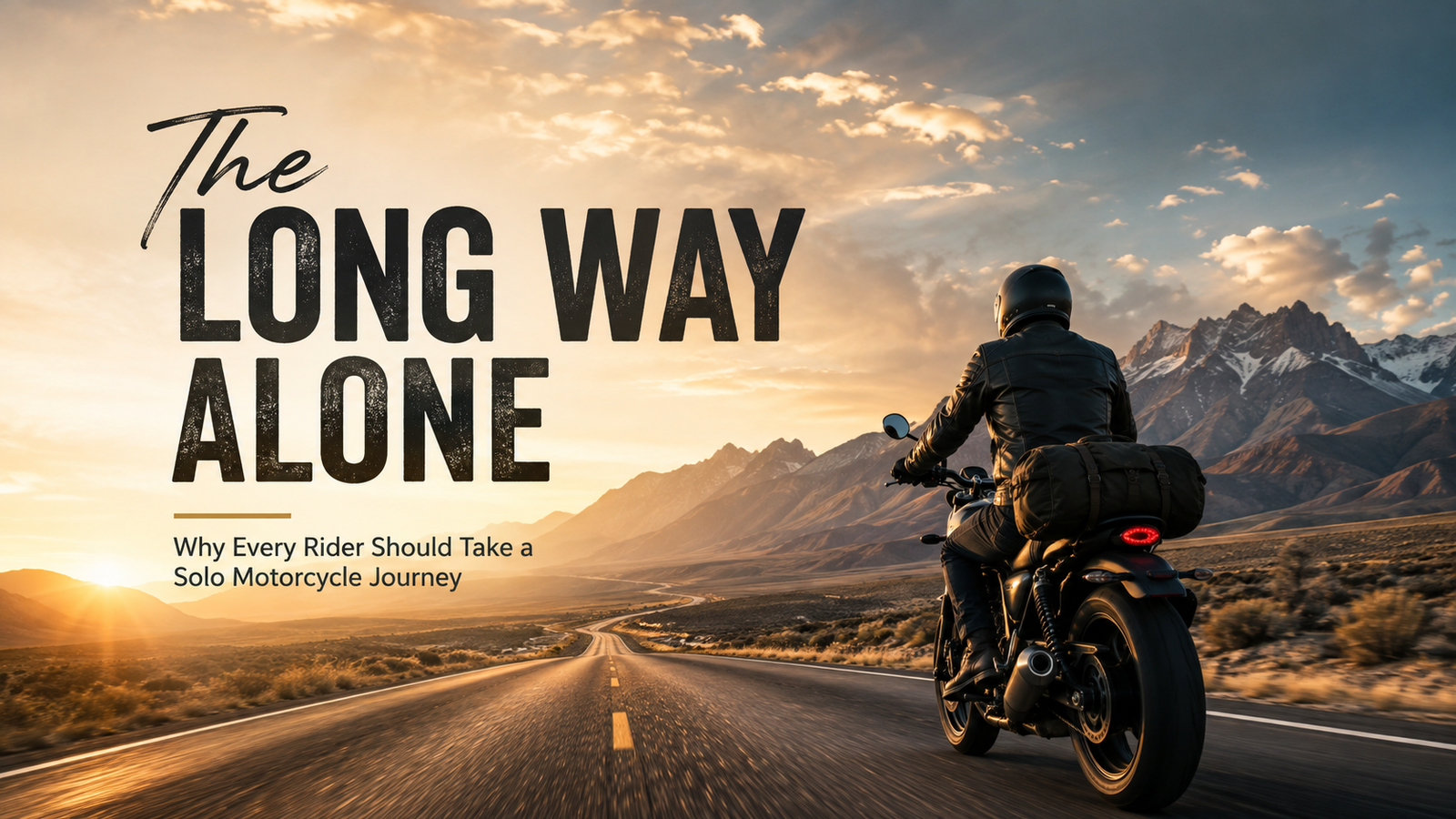
There is a moment on every long solo ride when the noise disappears. The engine settles into a steady rhythm. The road stretches beyond the horizon. The towns grow smaller, the traffic fades, and the world begins to feel wider than it did before.
You are alone—but not lonely. There is no group to follow, no conversation to maintain, and no one else deciding when to stop or where to turn. There is only the motorcycle, the road, and the thoughts you usually leave behind. That is the real power of riding alone.
Freedom Without a Schedule
Most of life is built around obligations. Meetings. Deadlines. Messages. Expectations. Even group rides require compromise. Someone wants to leave earlier. Someone needs fuel. Someone prefers the highway while another rider wants the back roads. A solo journey removes all of that.
You decide when the day begins. You decide how far to ride. You can stop beside an empty mountain road, spend an hour in a roadside café, or change your destination because a faded sign points toward somewhere interesting.
There is no wrong turn when the ride belongs entirely to you. The freedom of solo travel is not about avoiding people. It is about temporarily stepping away from everything that usually influences your decisions. For once, the road asks only one question: Where do you want to go next?
The Road Reveals Who You Are
Long-distance riding has a way of stripping life down to the essentials. Fuel. Food. Water. Shelter. Weather. Distance. Problems become immediate and honest. A storm does not care about your plans. A closed road does not care about your schedule. A mechanical issue will not disappear because you are frustrated.
When you ride alone, you learn to respond instead of panic. You become more patient. More observant. More resourceful. You learn how far you can push before exhaustion begins to affect your decisions. You learn when to keep moving and when pride needs to be replaced by caution. You learn that strength is not always about enduring more. Sometimes, strength is knowing when to stop.
The road does not create a new version of you. It reveals the version that was already there.
The Silence Becomes Part of the Journey
At first, the silence can feel unfamiliar. Without music, conversation, or constant notifications, your mind begins filling the empty space. Old memories appear. Unfinished thoughts return. Questions you have avoided become harder to ignore. Then, somewhere after the first few hundred kilometres, something changes. The thoughts become quieter. You stop replaying the past and predicting the future. Your attention moves toward the road—the next corner, the shifting wind, the changing light, the temperature dropping as the elevation rises.
You become completely present. That presence is rare in everyday life. On a motorcycle, it becomes necessary. Every movement matters. Every sound carries information. Every decision has a consequence. The ride becomes a form of meditation powered by fuel and motion.
Small Encounters Become Lasting Memories
Solo riders are rarely as isolated as they expect.
A fuel stop becomes a conversation with a local who recommends an unmarked road. A mechanical problem introduces you to a stranger willing to help. A shared meal at a roadside restaurant becomes one of the most memorable moments of the trip.
When you travel alone, people are more likely to approach you.
They ask where you came from. They ask where you are going. They tell you about the road ahead, the weather beyond the mountains, or the place you should stop before nightfall.
These encounters may last only a few minutes, but they remain with you because they become part of the story.
A solo journey reminds you that independence and connection are not opposites.
You can travel alone and still discover the best of people.
Preparation Creates Confidence
Freedom on the road requires responsibility before the ride begins.
A solo journey should not depend on perfect conditions. The motorcycle must be inspected. Tyres, brakes, fluids, lights, chain tension, and battery health should be checked before departure.
Your luggage should carry what you need without turning the motorcycle into a moving storage unit.
Pack reliable protective gear, weather-resistant layers, hydration, basic tools, emergency contacts, navigation backups, and enough flexibility to handle delays.
Tell someone your general route. Check weather conditions. Know the distance between fuel stops, especially when travelling through remote areas.
Preparation does not remove adventure.
It gives you the confidence to experience it.
You Do Not Need a Perfect Route
Many riders postpone long journeys because they are waiting for the perfect plan.
The perfect motorcycle.
The perfect weather.
The perfect amount of money.
The perfect week with no responsibilities.
That moment rarely arrives.
Your first solo ride does not need to cross a continent. It might be a two-day journey into the mountains, a ride through unfamiliar countryside, or an overnight trip to a town you have never visited.
Distance matters less than intention.
Choose a destination far enough to interrupt your routine. Take roads you have not ridden before. Leave room for detours. Give yourself permission to travel slowly.
Adventure does not begin at a certain number of kilometres.
It begins the moment the familiar disappears behind you.
The Rider Who Returns Is Different
Eventually, every journey turns toward home.
The roads become recognisable again. Traffic increases. Notifications return. Responsibilities begin waiting at the edge of the ride.
But something has changed.
You return with proof that you can handle uncertainty. You have solved problems without immediate help. You have spent long hours with your own thoughts. You have watched landscapes change because you kept moving toward them.
The confidence you gain does not stay on the motorcycle.
It follows you home.
The road teaches you that fear does not always mean stop. Sometimes, it simply means you are moving beyond what is familiar.
Take the Long Way
There will always be reasons not to go.
The weather might change. The route might be difficult. The distance might feel intimidating. You might question whether you are ready.
You may never feel completely ready.
Go anyway—but go prepared.
Choose the road that takes longer. Stop when the view demands it. Speak to strangers. Respect fatigue. Accept uncertainty. Let the journey unfold without forcing every moment into a plan.
A solo motorcycle trip is not about escaping your life.
It is about returning to it with clearer eyes, a stronger spirit, and a deeper understanding of what freedom feels like.
Sometimes, the road ahead is empty because it is waiting for you.
Ride far. Ride prepared. Ride your own way.There is a moment on every long solo ride when the noise disappears.
The engine settles into a steady rhythm. The road stretches beyond the horizon. The towns grow smaller, the traffic fades, and the world begins to feel wider than it did before.
You are alone—but not lonely.
There is no group to follow, no conversation to maintain, and no one else deciding when to stop or where to turn. There is only the motorcycle, the road, and the thoughts you usually leave behind.
That is the real power of riding alone.
Freedom Without a Schedule
Most of life is built around obligations.
Meetings. Deadlines. Messages. Expectations. Even group rides require compromise. Someone wants to leave earlier. Someone needs fuel. Someone prefers the highway while another rider wants the back roads.
A solo journey removes all of that.
You decide when the day begins. You decide how far to ride. You can stop beside an empty mountain road, spend an hour in a roadside café, or change your destination because a faded sign points toward somewhere interesting.
There is no wrong turn when the ride belongs entirely to you.
The freedom of solo travel is not about avoiding people. It is about temporarily stepping away from everything that usually influences your decisions.
For once, the road asks only one question:
Where do you want to go next?
The Road Reveals Who You Are
Long-distance riding has a way of stripping life down to the essentials.
Fuel. Food. Water. Shelter. Weather. Distance.
Problems become immediate and honest. A storm does not care about your plans. A closed road does not care about your schedule. A mechanical issue will not disappear because you are frustrated.
When you ride alone, you learn to respond instead of panic.
You become more patient. More observant. More resourceful.
You learn how far you can push before exhaustion begins to affect your decisions. You learn when to keep moving and when pride needs to be replaced by caution. You learn that strength is not always about enduring more. Sometimes, strength is knowing when to stop.
The road does not create a new version of you.
It reveals the version that was already there.
The Silence Becomes Part of the Journey
At first, the silence can feel unfamiliar.
Without music, conversation, or constant notifications, your mind begins filling the empty space. Old memories appear. Unfinished thoughts return. Questions you have avoided become harder to ignore.
Then, somewhere after the first few hundred kilometres, something changes.
The thoughts become quieter.
You stop replaying the past and predicting the future. Your attention moves toward the road—the next corner, the shifting wind, the changing light, the temperature dropping as the elevation rises.
You become completely present.
That presence is rare in everyday life. On a motorcycle, it becomes necessary.
Every movement matters. Every sound carries information. Every decision has a consequence.
The ride becomes a form of meditation powered by fuel and motion.
Small Encounters Become Lasting Memories
Solo riders are rarely as isolated as they expect.
A fuel stop becomes a conversation with a local who recommends an unmarked road. A mechanical problem introduces you to a stranger willing to help. A shared meal at a roadside restaurant becomes one of the most memorable moments of the trip.
When you travel alone, people are more likely to approach you.
They ask where you came from. They ask where you are going. They tell you about the road ahead, the weather beyond the mountains, or the place you should stop before nightfall.
These encounters may last only a few minutes, but they remain with you because they become part of the story.
A solo journey reminds you that independence and connection are not opposites.
You can travel alone and still discover the best of people.
Preparation Creates Confidence
Freedom on the road requires responsibility before the ride begins.
A solo journey should not depend on perfect conditions. The motorcycle must be inspected. Tyres, brakes, fluids, lights, chain tension, and battery health should be checked before departure.
Your luggage should carry what you need without turning the motorcycle into a moving storage unit.
Pack reliable protective gear, weather-resistant layers, hydration, basic tools, emergency contacts, navigation backups, and enough flexibility to handle delays.
Tell someone your general route. Check weather conditions. Know the distance between fuel stops, especially when travelling through remote areas.
Preparation does not remove adventure.
It gives you the confidence to experience it.
You Do Not Need a Perfect Route
Many riders postpone long journeys because they are waiting for the perfect plan.
The perfect motorcycle.
The perfect weather.
The perfect amount of money.
The perfect week with no responsibilities.
That moment rarely arrives.
Your first solo ride does not need to cross a continent. It might be a two-day journey into the mountains, a ride through unfamiliar countryside, or an overnight trip to a town you have never visited.
Distance matters less than intention.
Choose a destination far enough to interrupt your routine. Take roads you have not ridden before. Leave room for detours. Give yourself permission to travel slowly.
Adventure does not begin at a certain number of kilometres.
It begins the moment the familiar disappears behind you.
The Rider Who Returns Is Different
Eventually, every journey turns toward home.
The roads become recognisable again. Traffic increases. Notifications return. Responsibilities begin waiting at the edge of the ride.
But something has changed.
You return with proof that you can handle uncertainty. You have solved problems without immediate help. You have spent long hours with your own thoughts. You have watched landscapes change because you kept moving toward them.
The confidence you gain does not stay on the motorcycle.
It follows you home.
The road teaches you that fear does not always mean stop. Sometimes, it simply means you are moving beyond what is familiar.
Take the Long Way
There will always be reasons not to go.
The weather might change. The route might be difficult. The distance might feel intimidating. You might question whether you are ready.
You may never feel completely ready.
Go anyway—but go prepared.
Choose the road that takes longer. Stop when the view demands it. Speak to strangers. Respect fatigue. Accept uncertainty. Let the journey unfold without forcing every moment into a plan.
A solo motorcycle trip is not about escaping your life.
It is about returning to it with clearer eyes, a stronger spirit, and a deeper understanding of what freedom feels like.
Sometimes, the road ahead is empty because it is waiting for you.
Ride far. Ride prepared. Ride your own way.